

Abstract
The Middle East is undergoing a profound infrastructure transformation, with estimates suggesting trillions of dollars in projects planned or underway. This is driven by parallel dynamics: futuristic mega-projects in the Gulf and Egypt—such as massive sports infrastructure for global events like the World Cup and Asian Games—and monumental reconstruction efforts in nations like Syria and Libya. The sheer scale of these government initiatives creates an environment rife with complex risks. This article explores the diverse landscape of infrastructure projects across the region, supported by industry statistics on mega-project challenges. It argues that shifting to proactive, structural Risk Management is a critical necessity to streamline delivery and safeguard these immense fiscal investments.
Introduction: A Region of Massive Financial Stakes
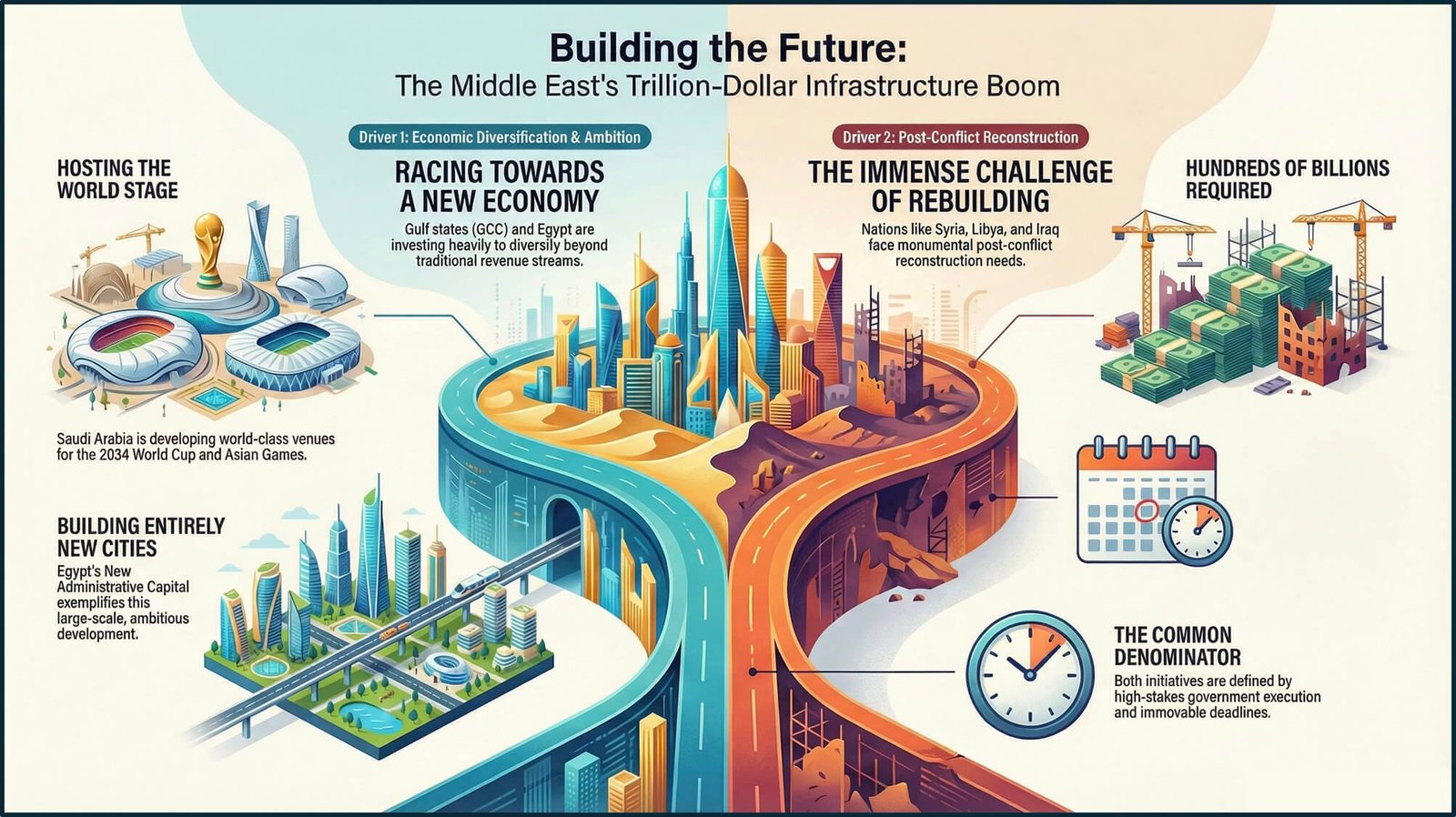
The Middle East is currently one of the world’s most active zones for large-scale infrastructure development. We are witnessing an era of unprecedented spending. Industry reports estimate the total value of active infrastructure and construction projects in the MENA region well into the trillions of dollars, underscoring the massive financial stakes involved.
This landscape is characterized by a unique dichotomy of ambition:
On one side, the Gulf Cooperation Council (GCC) states and Egypt are racing toward economic diversification. This includes Egypt’s New Administrative Capital and Saudi Arabia’s massive undertaking to develop world-class stadiums, transport networks, and host cities for upcoming global events like the 2034 FIFA World Cup and the 2034 Asian Games.
On the other side, nations like Syria, Libya, and Iraq face the immense financial and logistical challenge of post-conflict reconstruction, requiring hundreds of billions to restore essential utilities, housing, and transport networks.
Despite differing motivations, the common denominator is high-stakes government execution with immovable deadlines.
The Crucible: The Mega-Project Challenge by the Numbers
While infrastructure projects globally face hurdles, the specific dynamics of the Middle East intensify the challenge. Globally, the track record for mega-projects is sobering.
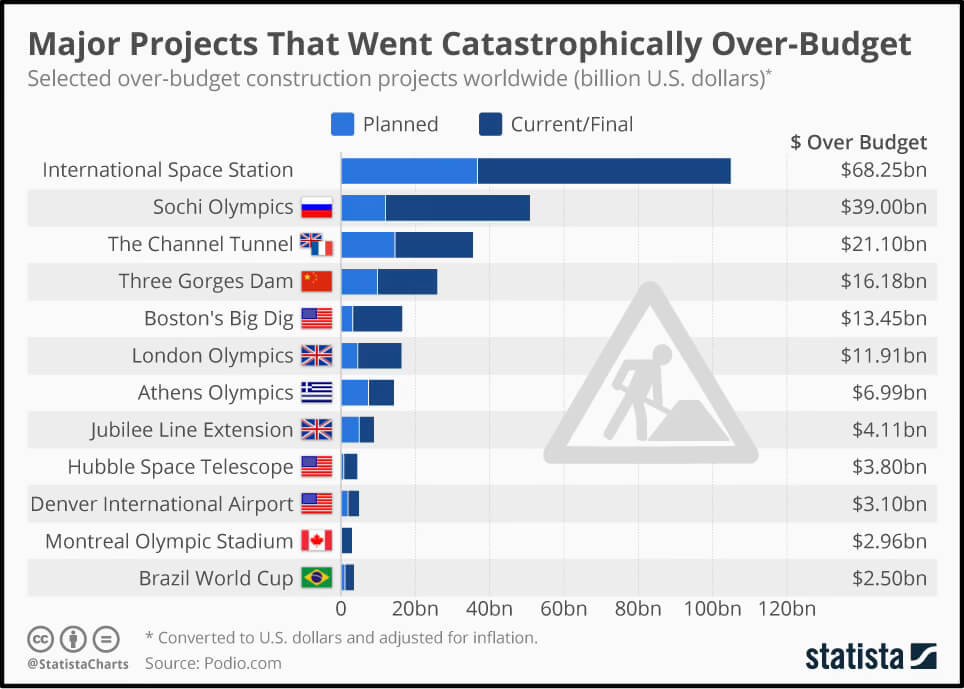
The Reality of Mega-Projects
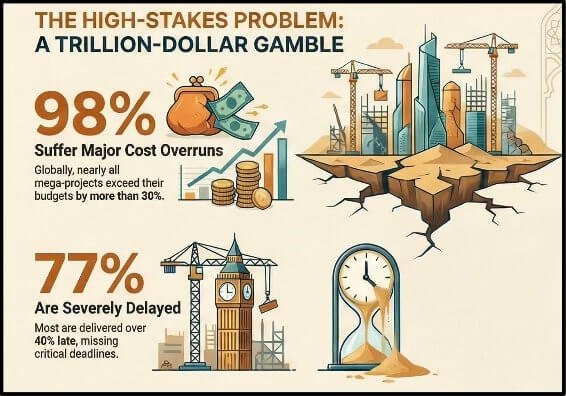
According to global studies on major infrastructure projects (such as those referenced by McKinsey and Oxford University’s Saïd Business School):
- 98% of mega-projects suffer cost overruns of more than 30%.
- 77% are eventually delivered more than 40% late.
In the high-pressure environment of the Middle East—with fixed sports event deadlines or urgent reconstruction needs—these statistics represent unacceptable strategic risks.
The region faces unique amplifiers to these global statistics:
1- The Scale and Novelty (Gulf & Egypt):
When constructing unprecedented sports venues under international scrutiny, historical data is scarce, making the “integration unknown” a primary risk driver.
2. The Complexity of Reconstruction (Syria, Libya):
Risks here include unexploded ordnance (UXO), fragile security, and indeterminate underground utilities.
3. Compressed Timelines:
“Fast-tracking,” where design and construction overlap, is common to meet fixed dates, inherently increasing rework risk.
4. Regional Supply Chain Strain:
The simultaneous launch of massive projects across MENA has put immense strain on materials and specialized labor availability.
The Game Changer: How Strategic Risk Management Streamlines Delivery
Moving from a reactive stance to a proactive risk culture is not merely about avoiding failure; it is about actively streamlining delivery and protecting value. Here is how an integrated approach transforms project execution:
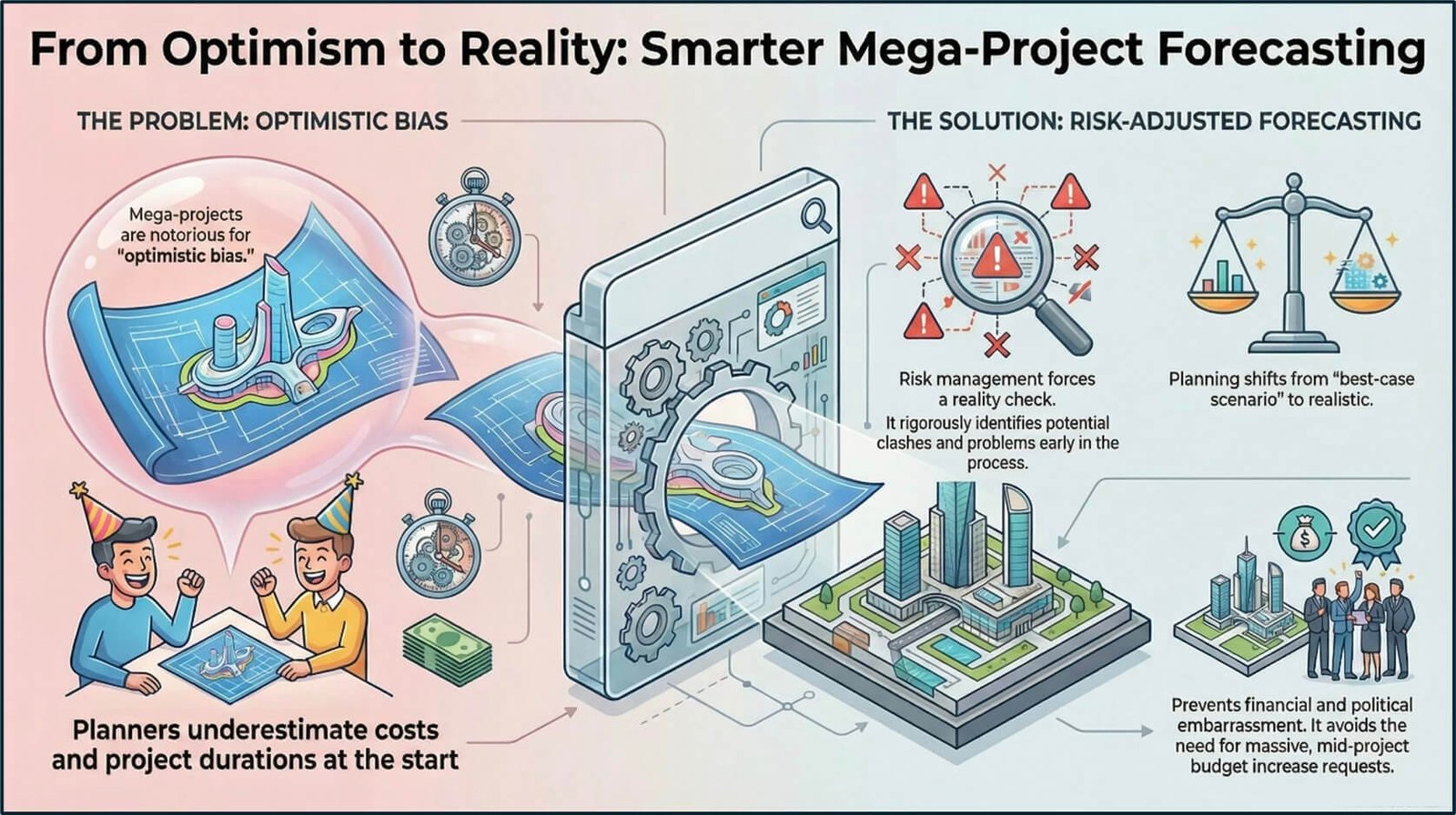
1. Moving from “Optimistic Bias” to Realistic Forecasting
Mega-projects are notorious for “optimistic bias”—underestimating costs and durations at the start. A robust risk management framework forces a reality check.
The Impact: By rigorously identifying potential clashes early, governments move from “best-case scenario” budgeting to risk-adjusted forecasting. This prevents the political and financial embarrassment of massive, mid-project budget requests.
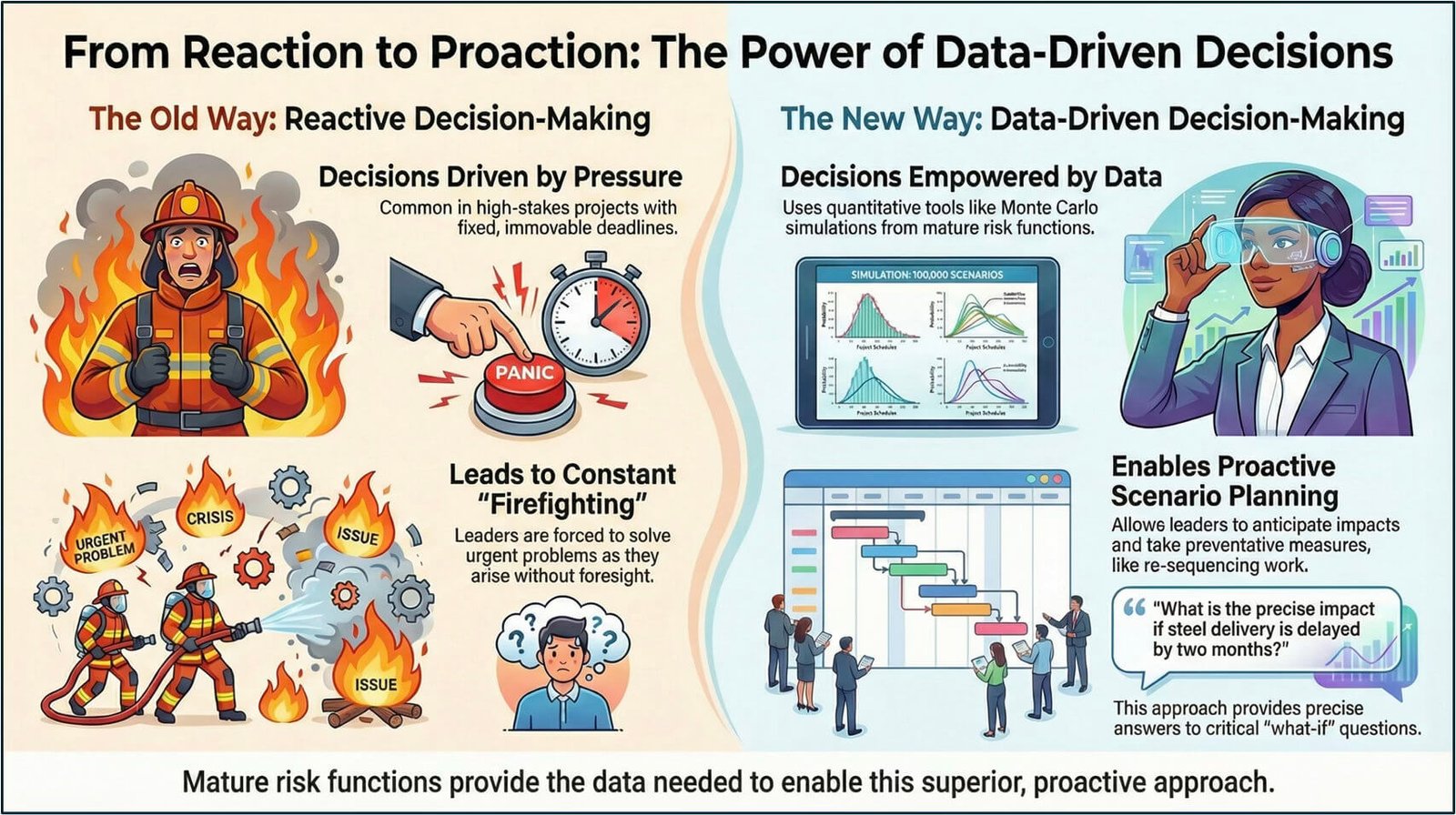
2. Empowering Data-Driven versus Reactive Decision-Making
In high-stakes government projects with fixed deadlines (like sports events), decisions cannot be based on pressure. Mature risk functions provide quantitative data, such as Monte Carlo simulations.
The Impact: This data enables stakeholders to perform scenario planning. “What is the precise impact if steel delivery is delayed by two months?” This allows leaders to take proactive measures—like re-sequencing work—rather than firefighting.
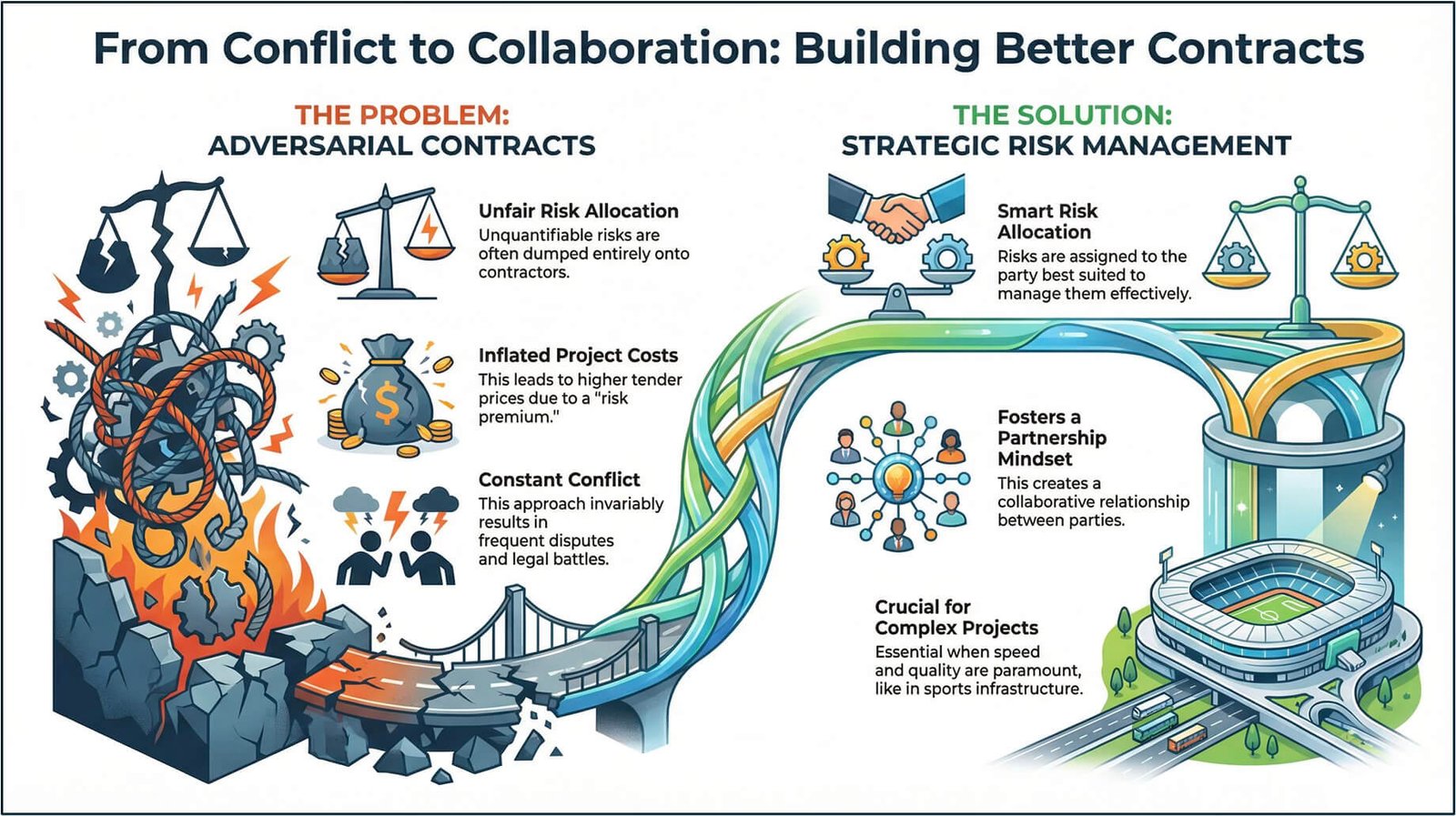
3. Contractual Clarity and Fostering a Partnership Mindset
Many disputes in the region arise from adversarial contracts where unquantifiable risks are dumped onto contractors. This invariably leads to inflated tender prices (the “risk premium”) and legal battles.
The Impact: Strategic risk management ensures risks are allocated to the party best suited to manage them. For complex, fast-track sports infrastructure, this fosters a collaborative relationship essential when speed and quality are paramount.
4. Enhancing Governance, Credibility, and Stakeholder Confidence
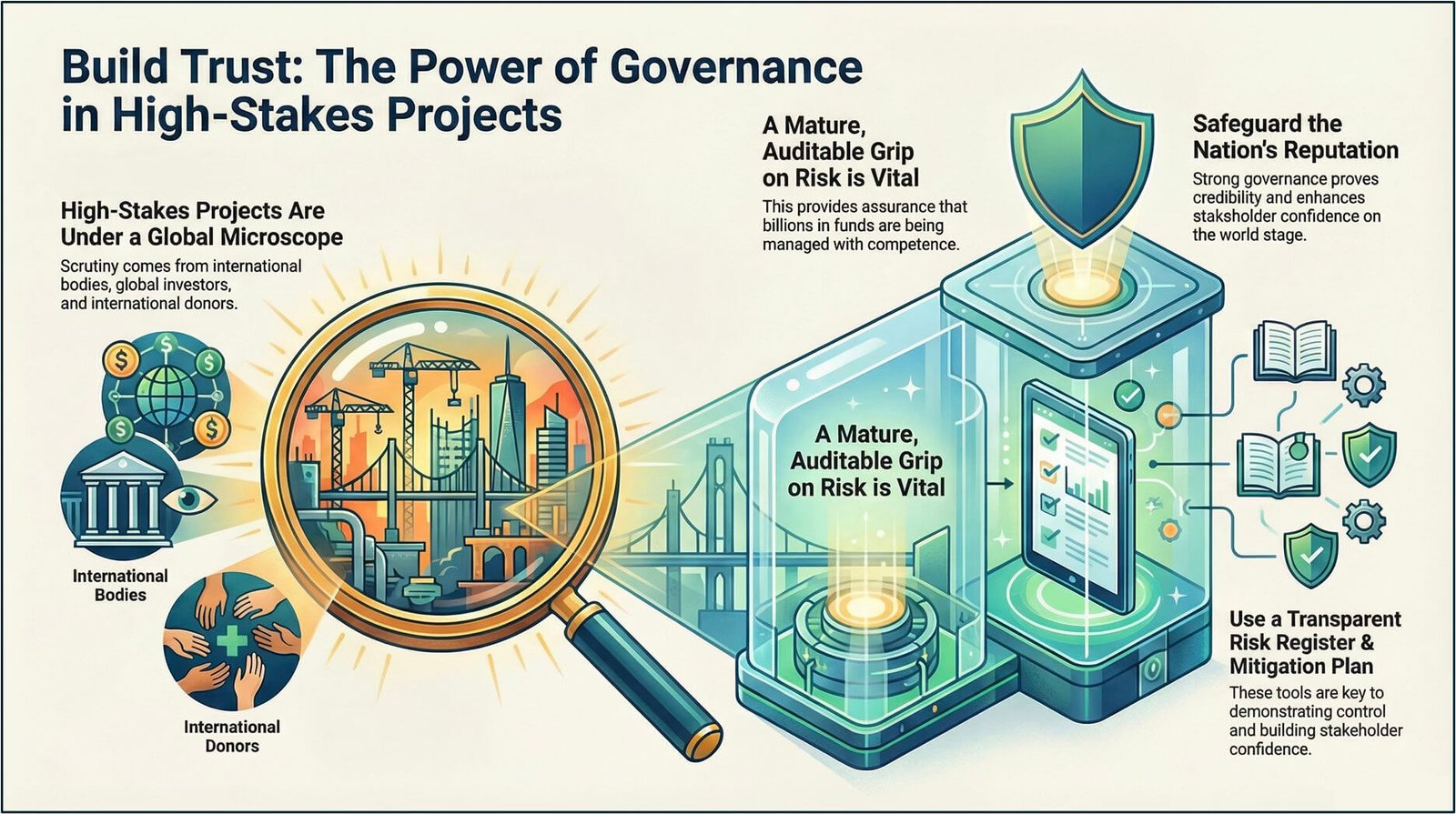
These projects are under intense scrutiny—from international bodies like FIFA, global investors in PPP models, or international donors in reconstruction efforts.
The Impact: Demonstrating a mature, auditable grip on risk is vital for credibility. A transparent risk register and mitigation plan provide assurance that billions of dollars in public or international funds are being managed with competence, safeguarding the nation’s reputation.
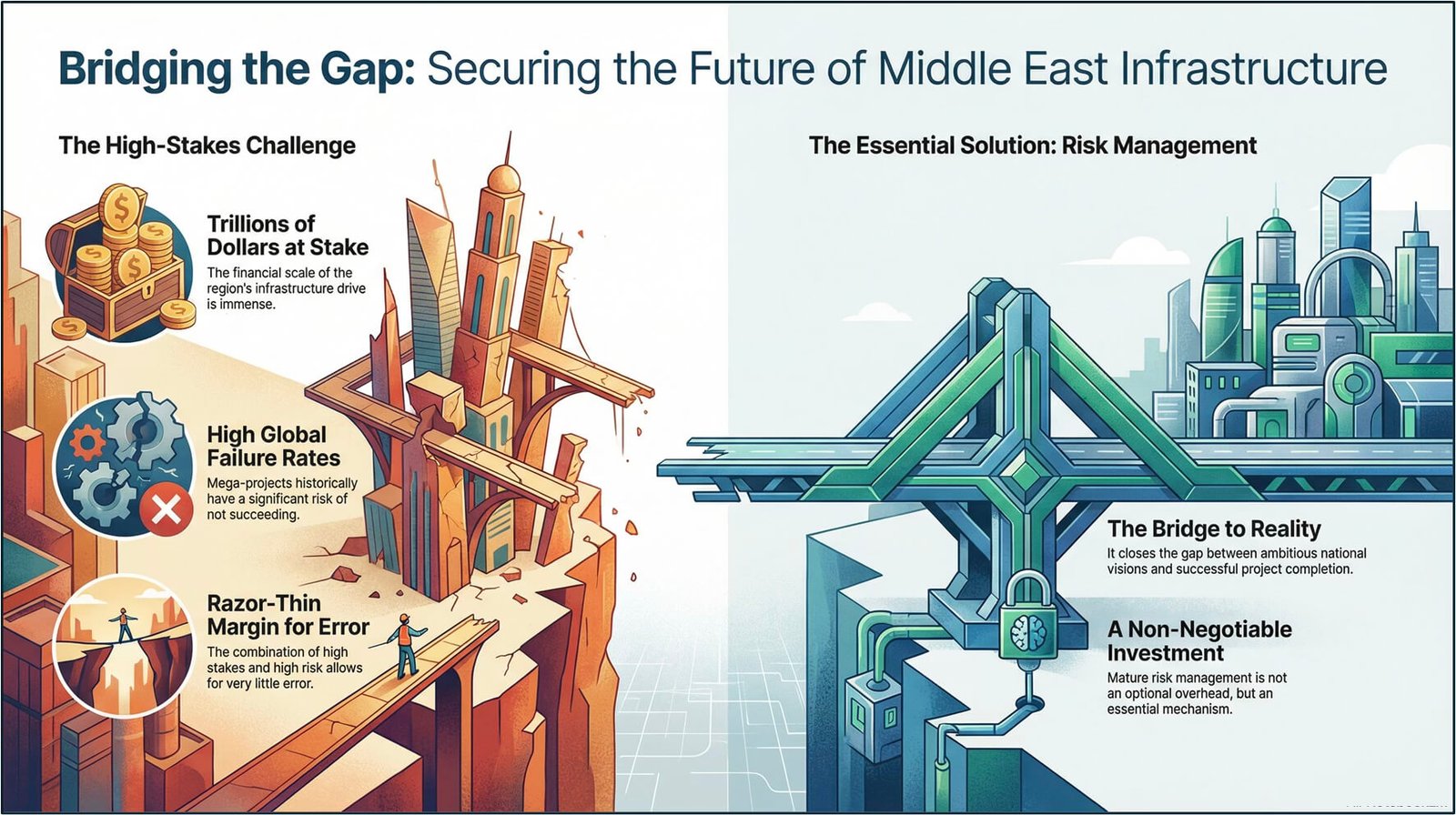
Conclusion: The Bridge Between Vision and Reality
The infrastructure drive across the Middle East is pivotal for the region’s future stability and economic diversification.
Given the trillions at stake and the historical failure rates of mega-projects globally, the margin for error is razor-thin. Investing in mature risk management capabilities is not an optional overhead; it is the essential mechanism that bridges the gap between ambitious national visions and successful, on-the-ground reality.